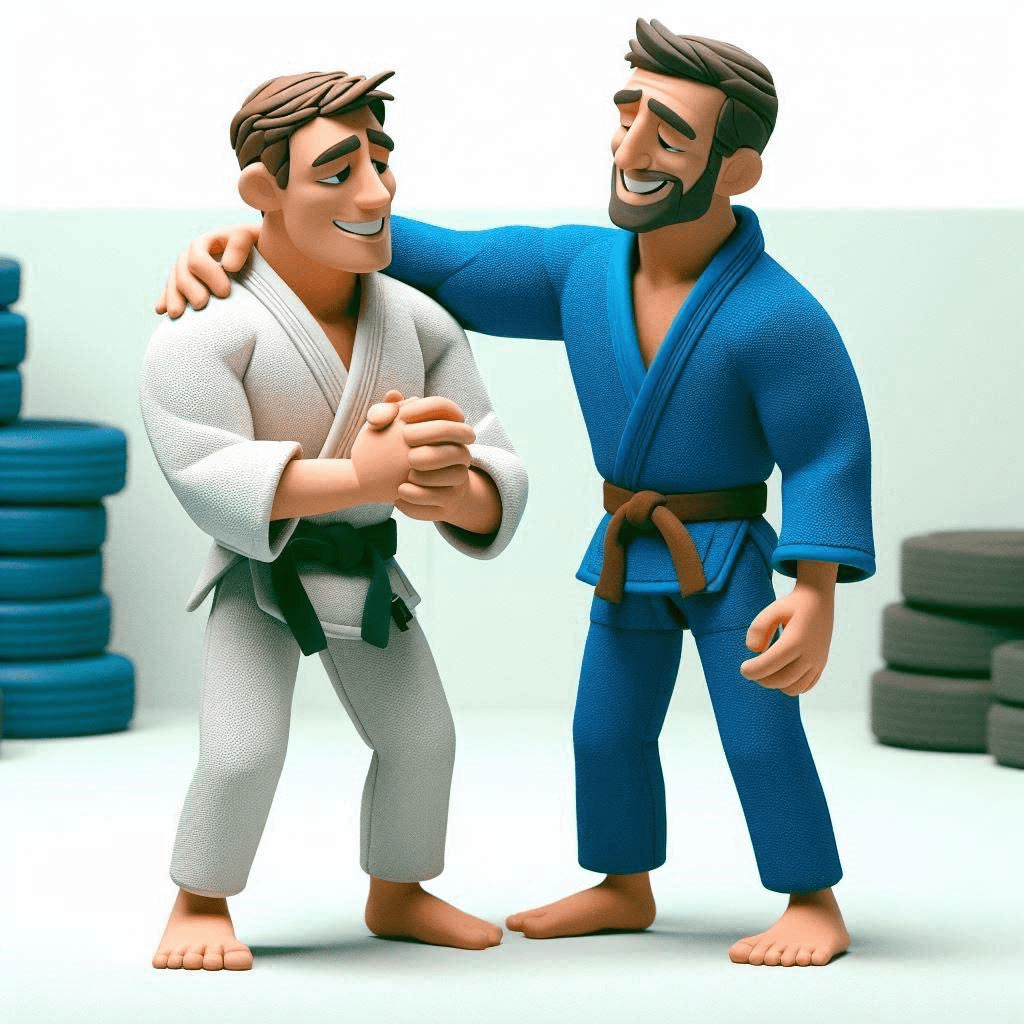
Don’t Be Weird
You know what I mean. But for those that don’t…try not to stare, and instead use good eye contact. Stop fidgeting and slouching and instead stand up straight with your shoulders back and chest out like the popular sculpting position called ‘Contrapposto.’ Own your space with certainty.
Simply be cool. Be friendly, but not too much of a nice guy (read: No More Mr. Nice Guy by Robert Glover).
At the same time, don’t be a conceded, know-everything asshole. Blend a perfect mix of confident and relaxed with approachable and composed.
This makes people respect you and want to be around you. And most importantly it will make people more likely to want to partner up with you.
Becoming the type of person I just described above is beyond the scope of this post. And probably not attainable for most people. Believe me, I’ve been trying for over a decade. But just going to jiu jitsu class regularly, will help with those personality characteristics.
This sport has a way of changing people for the better (most of the time). Also, grappling tends to filter out the goofs. Usually but not always. Don’t be weird.
A note on creepy…if you get paired up with a woman from your class, don’t be creepy. If you don’t know what that means, you might be creepy.
Match Their Intensity
Have you ever rolled with a person that felt like they were fighting demons?
It’s as if you are being used as a stress ball. It’s as if the tension they’ve accumulated throughout the week is being released onto you. It’s as if their unresolved trauma and shock is your fault and you must pay.
We’ve all been there. We might even be that person. But If I had one piece of advice to new white belts, it would be: chill the f*** out.
We want to have a good experience sparring and rolling with our partners, and the best thing to do is to match their intensity while rolling.
Have you ever heard of ‘mirroring’? “Mirroring is the behaviour in which one person subconsciously imitates the gesture, speech pattern, or attitude of another.” They say that this can be a good way to build rapport with others.
When you’re trying to match someones intensity, think of mirroring.
If they go hard, you go hard. If they want to flow roll, you flow roll. And everything in between. This is based on FEEL. Yes you can roll how you want, but if you roll too hard, some folks will avoid rolling with you.
That being said, I believe it’s good to roll with as many different types of people and styles, so your bjj game can absorb the breadth that the sport has to offer. Just be careful.
I’ve said it before and I’ll say it again: you can roll with whoever you like and you can not roll with anyone you don’t like. It’s your journey, do what you want.
Allow Your Partner to Practice the Technique
This comes down to patience and giving your partner the appropriate amount of resistance.
The person you’ve partnered up with may be a clumsy new white belt (or a clumsy blue belt with one stripe, like me). Allow them the space to fail and fail and fail, and give advice when asked or when needed. Don’t get frustrated when they get frustrated, show some maturity. This is tough because a blue belt only knows what a blue belt knows. For example, if someone asks me a question regarding a technique we’re practising, I give them details that I recognize but I always tell them that the head instructor knows best and to call them over for more clarification.
My wife is very competitive. Board games, card games, anything that involves competition. When we are at BJJ and she isn’t understanding the technique right away, she sometimes gets frustrated. I do my best to use encouraging language “You got this” or “That’s almost right, but here’s a detail that might help…” or “Let’s get (so and so) over here to show us the correct movement.” Encouraging language makes people feel comfortable even when they are failing.
And trust me, when I don’t use encouraging language or if I get frustrated and annoyed, we both feel it and our energy shifts. Just be aware that your demeanor can affect your partner. Keep that in mind.
A note on humility…it’s okay if you don’t understand and perform the technique right away. Jiu jitsu is hard and it will take a long time to get good at it. Some people pick it up fast while others not so fast. “Learn to be where you’re at.”
The other aspect of allowing your partner to practice the technique, is giving appropriate resistance. That means not going 100% defence and not allowing them to go through the motions of the submission or guard passing or whatever you’re learning.
Some people even ask me to give more resistance if they want to feel what it’s like when someone is trying to defend themselves from the technique. Ask your partner, or tell your partner how much resistance they/you want when learning a technique.
Don’t be weird. Match your partners intensity. And allow your partner to actually practice the technique you’re learning.
I’m still trying to master all of those and expect to be working on them for many years to come. Because one of my biggest goals in jiu jitsu is to become a good partner. If we learn well together, we all get better together. And if we all get better together, we can fight each other using really cool moves and become modern day ninjas. Isn’t that what we all want?

 There and Back