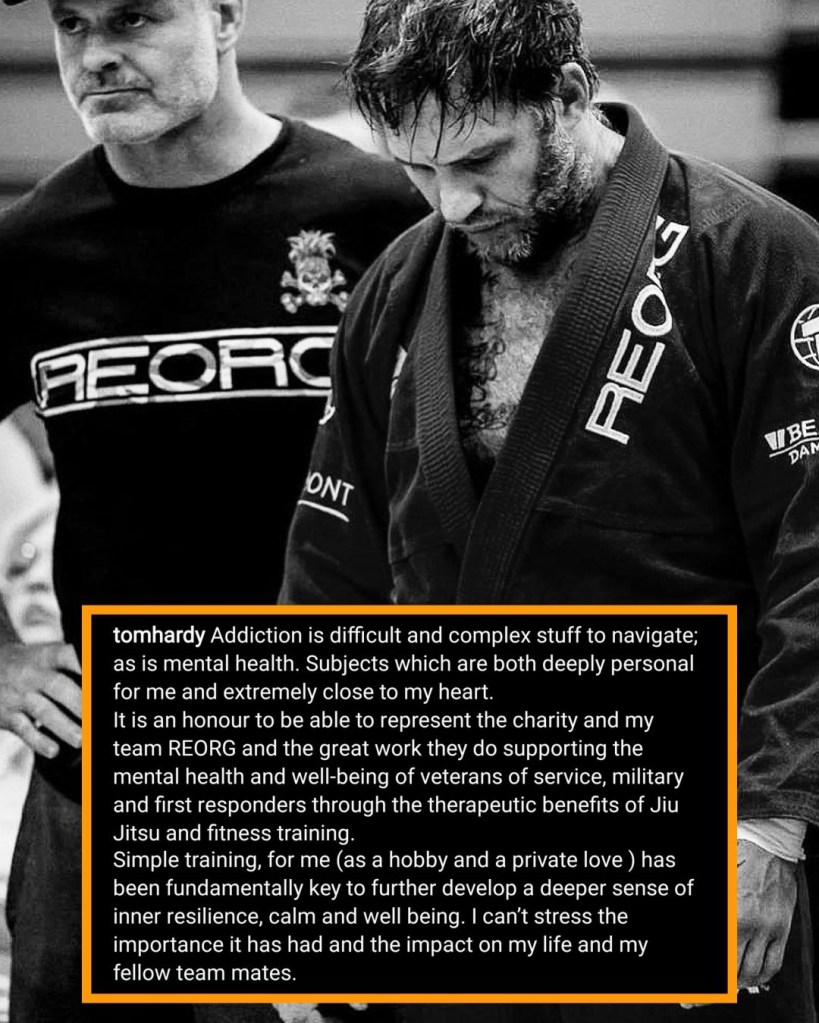
A journey. A return. Probably tired.

Tag: Pain

  • How to Avoid Injuries in Jiu Jitsu

    I definitely didn’t think I’d be doing a combat sport at this age, 38. After starting BJJ over two years ago, I have put my body through the ringer. I feel as good as ever, now that I don’t drink booze or do drugs anymore. But, I do have to remember that I cannot recover as fast after a hard training session or go as hard as I could if I was 10 or 15 years younger. Sometimes I forget that and that leads to injury.

    Lets talk about injuries in jiu jitsu.

    Imagine, you just showed up to class, you get changed in your nice clean gi, and head to the mat to do your warm ups and stretches. You say Hi to all the regulars. You’re feeling good. During the instructions and practice, you noticed you are understanding everything, it all makes sense. You’re hitting the techniques as if you knew them all along. So far so good.

    Then the sparring starts…

    You flow-roll with a purple belt, just to get a sweat going, not too hard. They even give you some advice and tips that you happily eat up. Then you roll with a new white belt, you don’t go crazy and tap them mercilessly, but you match their intensity and maybe even give them some advice after the roll and they happily listen and thank you for your tips. You feel on top of the world. But there’s one more round left. And the only partner left to partner up with is the heavy weight blue belt you were told to avoid. He never goes easy and always puts on subs like its a competition.

    But, you’re feeling lucky today. Today will be different. You’re pumped and motivated, you’ll finally pass his guard and take his back and slip in a smooth RNC. What could possibly go wrong?

    Fast forward to next week. You can’t train because your ego got the best of you the other day. Not only did you NOT pass that blue belts guard or get to their back, you pulled guard, all his wonderful 280lbs on top of your 160lbs. What were you thinking? Now your out for at least two weeks because you bruised some ribs.

    I’ve sparred like that. Not using my head and letting my pride cloud my better judgment. Being blinded by my self-importance. Succumbing to my hubris. I was dumb. And as a result, I got injuries that put me out for weeks and months. Although, I’m lucky I haven’t had a serious injury that has kept me out for a year or more or indefinitely .

    I train smarter now.

    You WILL get injured in jiu jitsu. From minor cuts and bruises to tendon and muscle rips to sprains and pulls to dislocation and breakage. And it mostly depends on what happens on the mats. But what you do off the mats is just as important to keep your body from being permanently injured.

    Here are some ways that I have avoided serious injury so far after two years of jiu jitsu and seven competitions:

    -find the sweet spot in your training schedule
    -trusted training partners
    -have perspective (the long game)
    -exercise

    The Sweet Spot

    I’m pretty sure I’ve mentioned before somewhere on this blog, the importance of having a training schedule that works for you. 3-4 classes a week is my sweet spot. I’m not a professional grappler and I have two jobs and a wife and dogs. I have plenty of other things to take care of and other hobbies that keep me busy everyday. Even if you can only train once or twice a week, that’s better than the people who are sitting on the couch every day (I’m writing this as I sit on my couch).

    The Trust

    After two years of training almost every week, I’ve learned I can make my training my own, I can customize it. For example, I can go when I want and I can train with who I want. Don’t feel obligated to train with every person who asks you to roll. Although I say Yes nine times out of ten, there are times when I simply want a rest round, or I don’t feel like rolling hard with the heavy white belt. And that’s okay. Find a training partner who you’ve rolled with often, about the same size, and a person who knows how to control their body. Trust me, I know what it’s like to let my ego get the best of me and end up rolling with the person that is rough and will probably hurt you.

    The Long Game

    Roll and spar with the intent to learn. You don’t “win” practice. Be smart with it. This is advice for me as well. Heck, I love a good competitive roll. You know the ones, where you and your partner are all over the mat, almost rolling into the other people on the mat. But doing that every class or every open mat can be dangerous. You might become one of those people I warned you about, the ones that are rough and will hurt you.

    Don’t become a training partner that people say say No to because they’re afraid that you might go too hard and hurt them. We all want to be able to go to work the next morning and show up to training the next day as well, in one piece. Think of the long game. Hopefully you’re committed to jiu jitsu for many years to come, I know I am. As long as we’re smart with our training we’ll make it to black belt without any serious permanent injuries. Hopefully.

    The Crew

    I asked people on X/Twitter, “What are some ways you have learned to avoid serious injuries in BJJ?”

    So far I got over 30 responses. I’ll share them with you here:

    “Stretching daily and lifting weights to build up that armor. Tap early, drink water, and sleep good.”

    “Tap early early. Once they get it locked, its over. You fucked up a long time ago.”

    “Tape up & Tap quick!”

    “Consistent strength and conditioning has allowed me to be stronger and more stable in many different ranges of motion regarding joints. It has also helped improve my mobility. Conditioning helps too, because it’s easier to prevent injury when you not completely gassed.”

    “I’d like to emphasize two things: – Sleep – Hydration”

    “Train more and if you don’t feel good, stay away make sure you get a lot of good stretching and then ice up when you come back maybe you have to just stretch again and then tape”

    “Lift weights”

    “1) always stretch and warm up
    2) tap early and often|
    3) very careful with body weight in free fall (no jumping guard etc)”

    “Tap big guys fast or tap before they tip it off”

    “Choose training partners carefully. Don’t be afraid to say no to the heavyweight white belt with a massive ego.”

    “Roll slow and avoid scrambles. Make tucking your chin a reflex if you go airborne. Listen to your body.”

    “Study anatomy and physiology”

    “Tap quick, don’t be tough in practice”

    “Not every roll is ADCC finals”

    “Had a purple belt almost break my wrist and elbow today. Some guys never drop that ego. Guy had 100+ lbs on me and asked how long I’d been training. When I told him, he said “ah I don’t feel bad then..” Avoid those dudes like the plague”

    “The first “invisible jiu Jitsu” skills I learned were to never c grip in bottom. Monkey grip or lose your thumbs!”

    “Defaulting to a chill/flow-y rolling style is a big one. I still get in hard rounds when I roll w/ certain ppl, but I default to being calm & technical. Also, having a strength & conditioning routine. My body feels better now at 33 than it did in my mid-20s.”

    “Know when I need to avoid rolling that day, instead of feeling compelled to roll every single time I step in the gym. If my body doesn’t feel right I just do class”

    “Tap early. Stretch. Good nutrition.”

    “Avoid training or sparring lol. On a serious note: 1) strength and conditioning (legs and back in particular) 2) don’t start from standing when the gym is too crowded 3) Rest and don’t overtrain – don’t be too hard on your body”

    “Every roll doesn’t have to be a competition. Sometimes you work on defense & if they’re real spazzy control the position until they get tired. Then have some fun”

    “Lifting weights helps too”

    “say no when asked to roll with a spazzy white belt”

    “Warm up. Tap early.”

    “Tap
    Get stronger”

    “Train calm and slow”

    “Tap early. Avoid people who spaz out.”

    “Overtraining causes slot of injuries. Take days off.”

    “Avoid big white belts, avoid big blue belts, avoid competition guys, tap immediately on leg locks, skip competition classes, don’t roll when cardio is cooked.”

    “Don’t talk politics or religion in class lol”

    “Avoid new people, avoid heavyweights, avoid your ego”

    Some good advice there, I agree with most of it.
    How about you, what have you done to help you prevent injuries in BJJ?

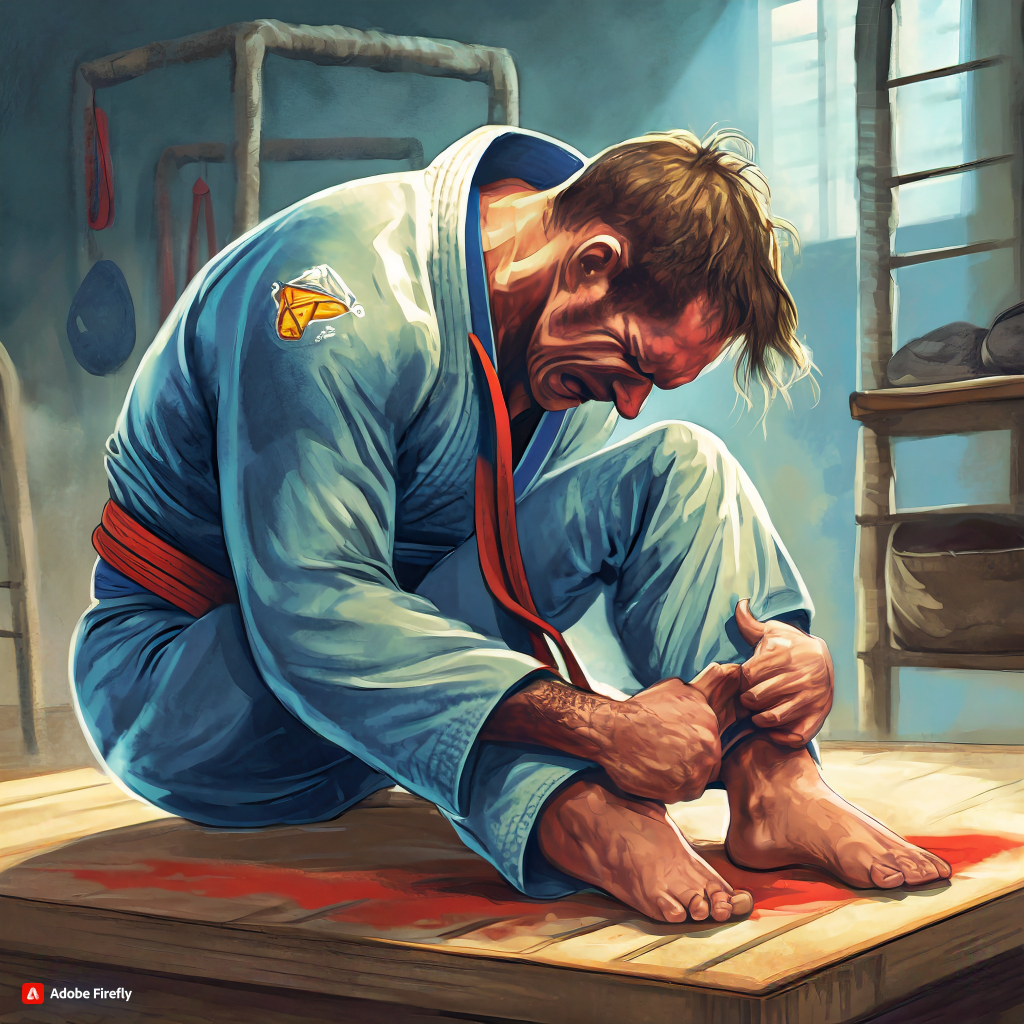
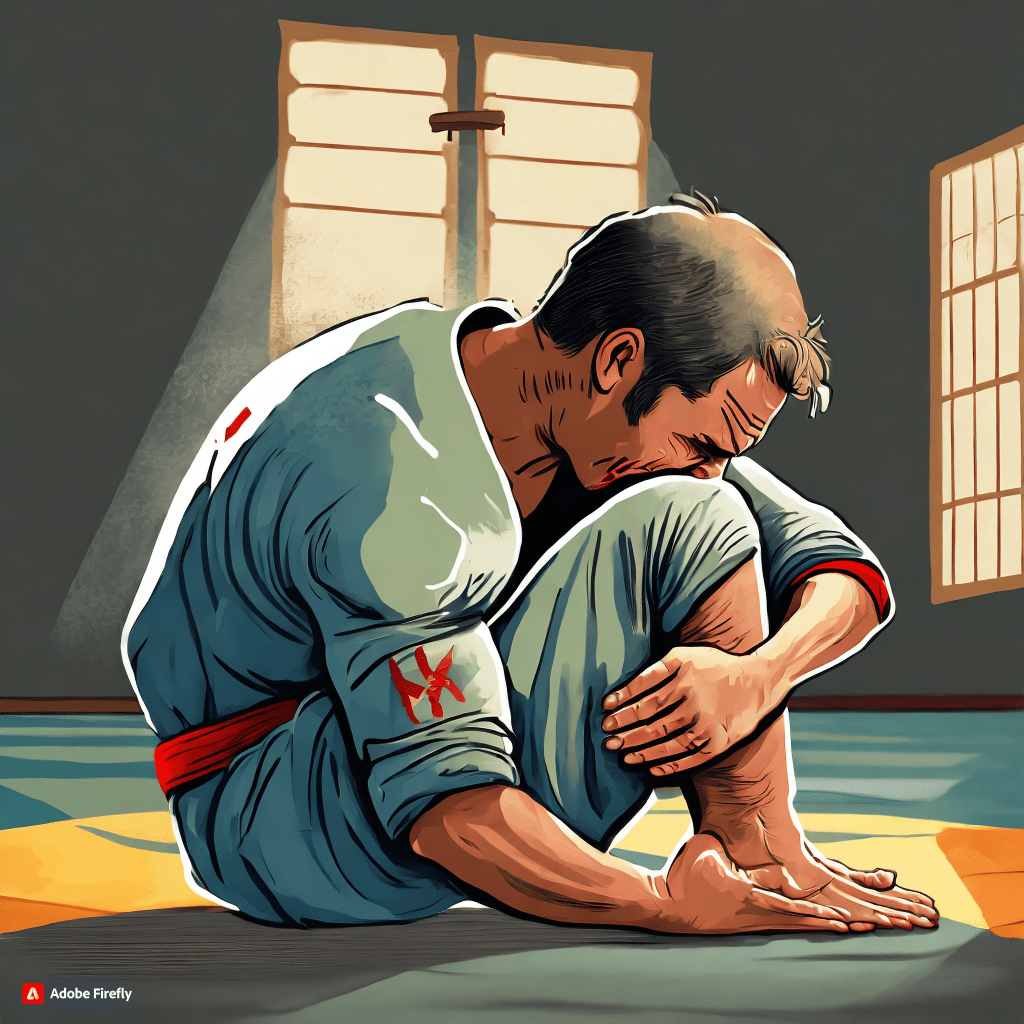
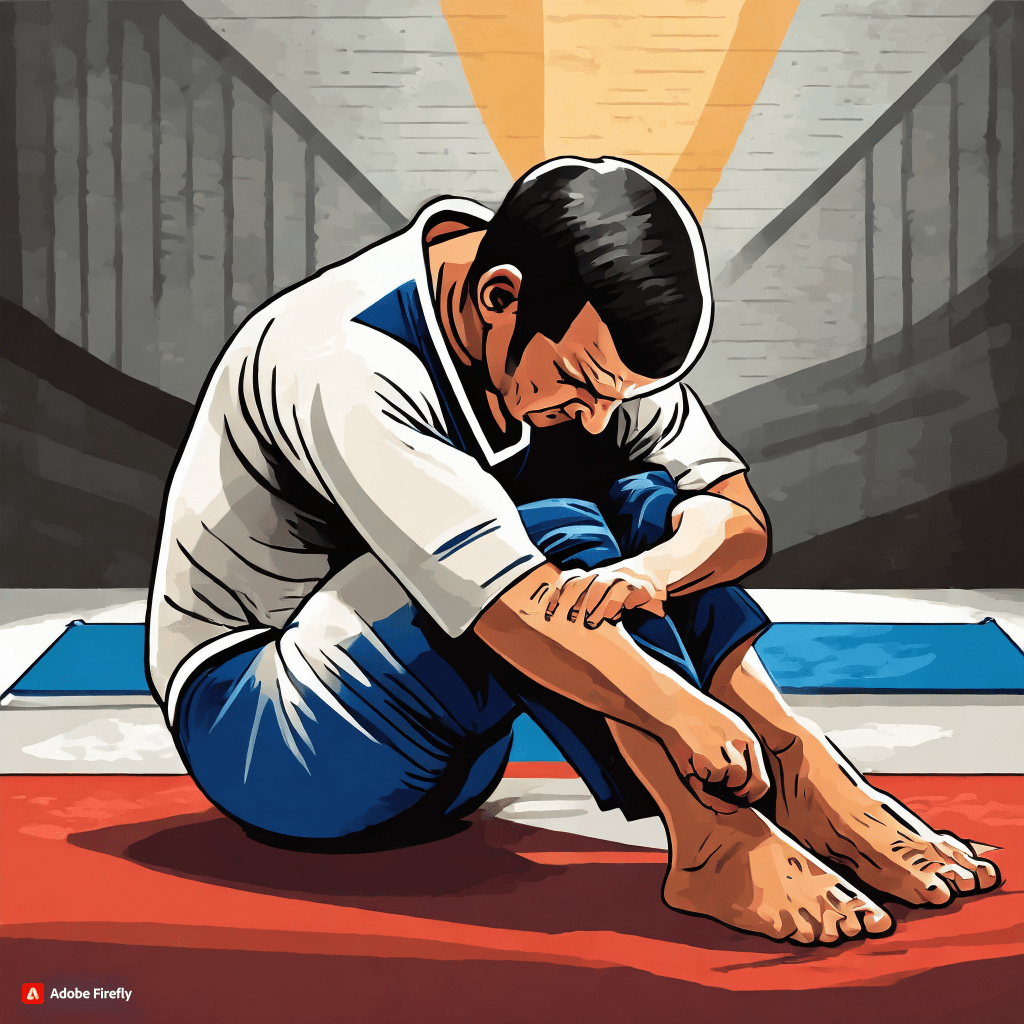
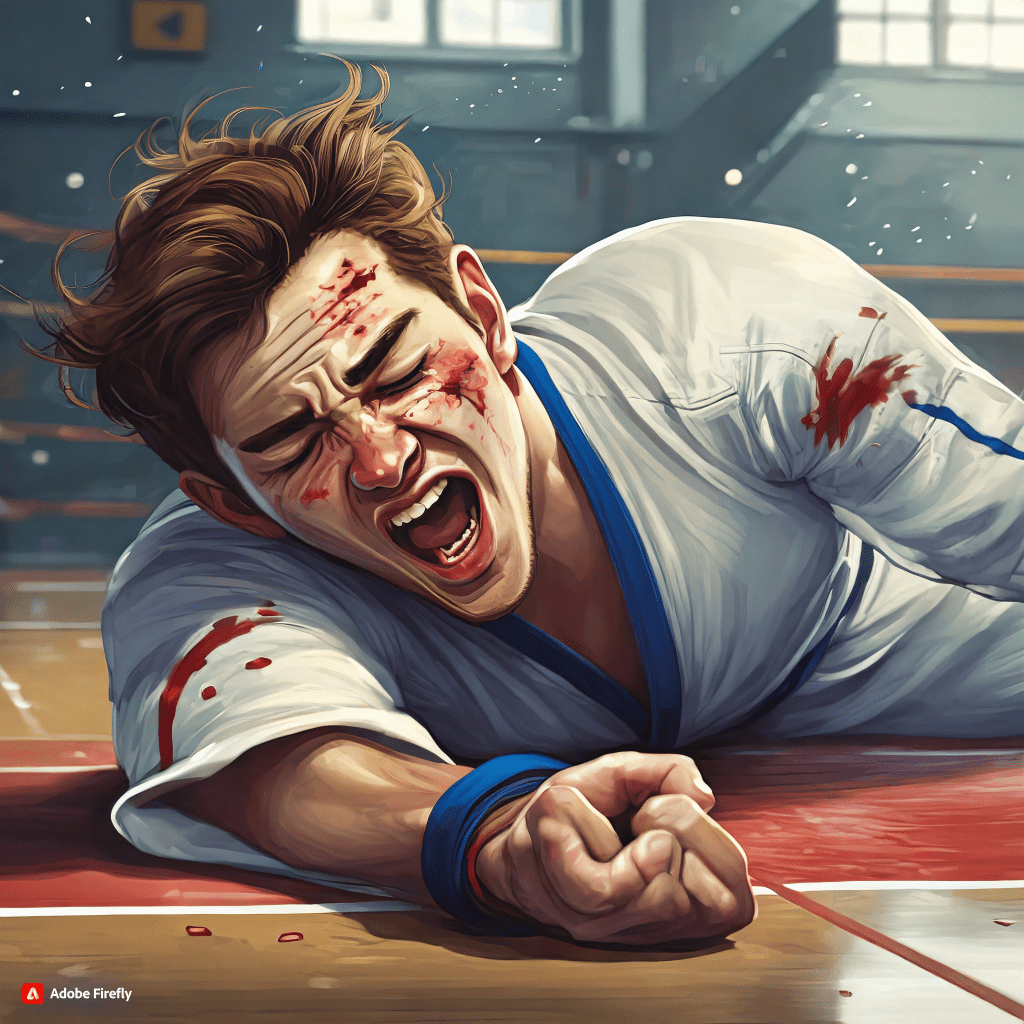
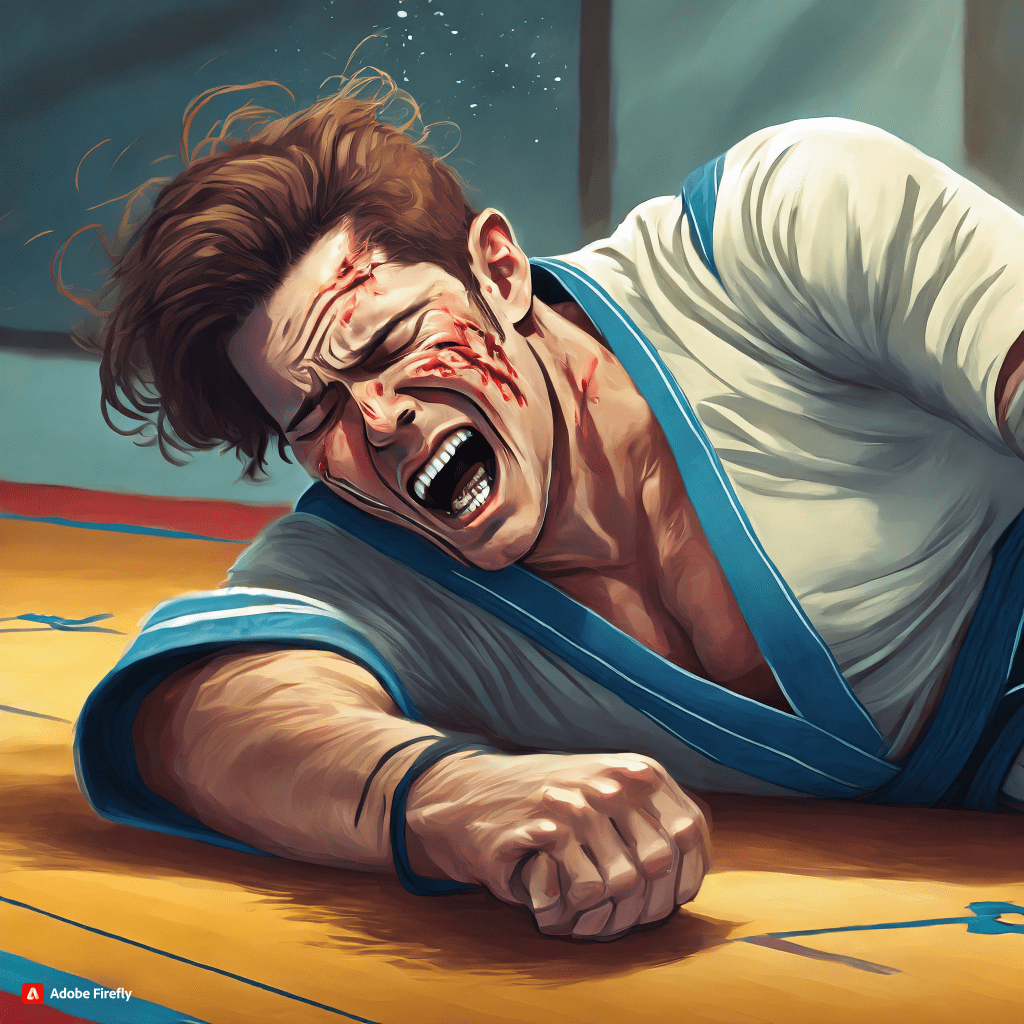
    Here are some A.I. generated images from Adobe Firefly, using the prompt, “Jiu Jitsu man in pain injuries crying on the mats laying down”
  • The Art of Fear and Embracing Vulnerability in Jiu Jitsu

    Fear and jiu jitsu go hand in hand.

    Fear of signing up for a martial art.

    Fear of looking weird in a Gi.

    Fear of looking stupid while you’re training.

    Fear of injury to yourself or others.

    What exactly are YOU afraid of?

    Signing Up

    When I first signed up for jiujitsu, I was quite intimidated. Yes I used to grapple and wrestle in high school for six years, and I knew what it was like rolling around the mat with other people. But seeing all the different belt ranks made me feel inadequate. I thought I was out a place, like I didn’t belong. One time it actually happened pretty recently. Last week I went to a GB3 black belt and competition class. This class has blue, purple, brown, and some black belts in it. I definitely felt out of place. They were doing techniques I’ve never done before, and they also all had camaraderie that was built up over many years of knowing each other. I knew a few people in there but I’m not super close with them. At 37 years old I actually felt a little shy for the first time in a long time, the last time was probably when I went to my first jiujitsu class.

    Dealing with the fear: what exactly are you afraid of? Think long and hard and heavy on what exactly it is that makes you not want to sign up. Hey, maybe you’re not interested and that’s OK a lot of people aren’t. But if you are interested in signing up for a bjj class then do some research, ask around on social media, check out YouTube videos, or drop in to a gym and ask a bunch of questions, or you could even email or message a gym on FB. That’s exactly what I did, I reached out to the gym I’m currently with and asked about free trial sessions. I bet some anxiety and stress from fear could be alleviated if you simply had your questions answered.

    Wearing a Gi

    Putting on a gi for the first time feels weird. I certainly didn’t feel as cool as I thought I would, like those martial artists in all those movies I watched growing up. “Everyone else looks better than I do” is what I often thought. Gi’s can be heavy, uncomfortable, and basically not fit well. Months in to my jiujitsu journey I didn’t really feel comfortable wearing my gi. And I don’t mean physically comfortable I mean mentally comfortable. Perhaps during those first eight months I didn’t feel like I belonged in my gi or that I didn’t look cool in my gi. And now after over a year and a half in my jiujitsu journey, I definitely feel like a martial artist and that I look cool in my gi.

    Dealing with the fear: what exactly are you afraid of? We want other people to like us and we want to feel comfortable in our own skin and feel confident about ourselves. Image is important to us. “What if they don’t like me or what if they make fun of me?” we might say to ourselves. But in reality , and I’m sure you’ve heard this before, most people are way too caught up in the intricacies of their own lives and the problems they have that they don’t think about you for too long. Most of the fear you have about what others think about you is all in your head. It’s taken me 37 years to finally realize that.

    Training Skills

    Even if you’ve been training a short period of time with jiujitsu, you know this all too well. Especially if you don’t have any grappling background or any athletic skills at all. Rolling around on mats with strangers trying to fight each other, in this case choking and limb locking, is such a trip. Our bodies were made to move, and if you’re able to, jiujitsu will feel weird. That’s why in the fundamentals class I go to, there is a focus on basic body movement, such as, rolling forwards and rolling backwards, hip escaping, butt scooting, and break falling. Even someone who’s uncoordinated, learning these basic body movements can help you feel more in tune with your body, so then you can eventually feel more in tune with your body while you’re fighting somebody. Jiujitsu has thousands of techniques, and I’m pretty sure there’s no person on planet earth that knows all of them. When you’re first learning this martial art, you will look silly, will look dumb, you will look uncool. But guess what, everybody does when they first start!

    Dealing with the fear: what exactly are you afraid of? Chances are you’ve never been in a real fight before and that’s okay a lot of people haven’t. When I first tapped to a submission in my first class I was scared sh*tless. There I was thinking I’m a hot shot with my wrestling background, being choked like I’ve never been choked before. It was wild. Your body and mind will go into Fight or Flight or Freeze Modes. That’s normal. To deal with this particular fear. break it down into small pieces. Don’t rush yourself. Don’t expect to be tapping and submitting people right away. Start with the basics of moving your body properly for jiujitsu. Then once your body has adjusted to the new-norm, that is, you fighting every week by rolling around in positions that you’ve never been in, then you can really start to open up to the martial art.

    Injury Prone

    Since the first day I started my jiujitsu journey over a year and a half ago, there hasn’t been a week that went by that I wasn’t nursing some type of pain that was a direct result of training. I’ve been lucky I haven’t been out for longer than three weeks with an injury. All the injuries were due to me not rolling smart or safe. Nobody wants to hurt anyone else (unless they’re an idiot). Jiujitsu is interesting, you’re trying to submit your opponent but you don’t want to permanently incapacitate them or prevent them from functioning properly again, at least a good training partner doesn’t want to. I remember seeing a video on social media of a person becoming almost paralyzed because their training partner did some sort of jumping back take. Lots of people with lots of opinions about who was in the wrong. But for me, it was a stark reminder of how dangerous this sport can be. Just be careful.

    Dealing with the fear: what exactly are you afraid of? I’m not gonna lie to you, jiujitsu can be dangerous. It’s a self-defence and it’s a sport. People get hurt and permanently injured and cannot come back for months or years or ever. Like I said, I’ve been lucky. I haven’t experienced a debilitating injury. I constantly renew an old shoulder injury, and a nagging back rib injury, but my activities of daily living or not inhibited. I can still do what I want. So how do we deal with this type of fear? Train smart and train safe. Use your fight or flight or freeze mode to your advantage, gain control of it and know how you react in survival situations in BJJ. For example, how would you react when you have a person who is eighty to a hundred pounds heavier than you sitting on top of your chest and possibly smothering your face? Or if someone has back control on you, and they slipped in a rear naked choke, and it’s getting tighter and tighter and tighter? The truth is, you won’t know until you’re in it.


    The fear of being judged or being permanently injured may never go away, but you certainly can mitigate the effect it has on your life.

    Talk to your fellow teammates and ask them how they deal with it.

    Seek out support wherever you are lucky enough to have it.

    Embrace and enjoy each of the small victories you have on the mats. You’ve earned them.

    And the more you expose yourself to the trials and tribulations of the jiujitsu journey, the more you’ll be able to turn it into an adventure.

    Manage the fear. It will take time, but it will get better and it will become easier.

    You don’t have to feel vulnerable, weak, exposed, or helpless when it comes to your jiujitsu journey. With enough time and effort, you will instead feel secure, resilient, empowered, and prepared. So keep showing up and keep fighting.

    May your sweeps be quick and your submissions be swift. See you on the mats.

  • Struggle, Pain, and Jiu Jitsu OR Why You Might Be Missing Something in Your Life

    There’s something fun about fighting everyday. It makes me feel alive. Everyone should learn how to fight. Preferably in a controlled, safe, and friendly environment (although not everyone can). To learn a martial art. If you have a friend who does jiu jitsu, they probably wouldn’t shut up about it when they first started. Telling you “You have got to try this!”

    There is a meme that refers to white belts getting really excited the first few weeks and months. Spazzy and high energy to the point of injury. Yes that happens and yes I’ve done it. Maybe there was something missing in our lives that the weekly grind of someone trying to choke us and break our limbs is giving us. Let’s dig a little deeper on that, have some fun with that idea of us missing something in our lives that struggling in BJJ (or any martial art) can give us.

    Fighting and Flying

    When you fight (called ‘sparring’ in jiu jitsu) your body and mind go into Fight or Flight mode. Your body and brain thinks you’re going to die. In a street fight that may actually happen. But in a controlled, safe environment like a bjj gym, your body and mind can’t tell the difference in the moment. They think you’re going to be killed by an attacker. Your body and mind are flooded with chemicals like adrenaline and cortisol. Your pupils dilate. You sweat. Your breathing quickens. Your heart races. Everything about you is telling you to “Get out of there!”

    When you start jiu jitsu, one of the first aspects about defence is controlling your breath. If you can slow your breathing down and control your breath when someone has full mount on you or has taken your back and is about to tighten a rear naked choke, your mind can plan your escape. If you’re a higher belt, this reaction becomes immediate (I’m guessing as I’m only a white belt at the moment). Second nature. They’ve been put in this situation so many times their body and mind are used to it. They know how to take care of themselves. Their Fight or Flight mode is tempered, or at the very least, managed to the point that it doesn’t negatively effect their BJJ techniques.

    Something is Missing

    Fighting and sparring every week is a struggle. Add in the fact that you have three different jobs, dogs to take care of, a relationships to maintain, a car that needs repairing, bills coming due, a family member is sick, etc. Why on earth would you also put your body and mind through jiu jitsu? Because we need struggle in order to know what is important to us. We need the right kind of pain that’s worth enduring. Struggle and pain makes us who we are. Don’t wish to not ever feel pain. Wish to have the right kind of pain.

    Brazilian Jiu Jitsu inflicts a specific kind of pain. There is the physical toll your body takes from sparring every week. There is the mental weight our mind endures by constantly getting submitted or feeling like you’re not getting any better at the martial art. And there is the spiritual beating we undergo as we wonder why we’re even here in the first place, if we are worth it, and if we made the right decision to put our mind and body through this weekly conflict.

    But this type of struggle is exactly what we need. Struggling in BJJ puts life’s other struggles into perspective. If you can endure someone trying to choke you everyday, you can endure those silly problems that come up at work or at home. Maybe what you’re missing is the physical, metal, and spiritual struggle that BJJ can provide.

    Struggling in BJJ shows us the right kind of pain we need to endure. Pain is life. Figure out what is worth struggling for. Try jiu jitsu.

    RELATED POSTS…

    FULL ARCHIVE…