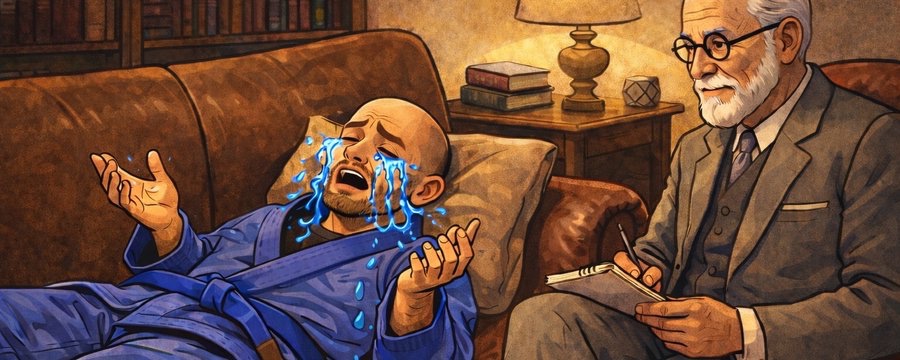
The first time I tried jiu jitsu was in 2017. I was a drunk druggy bum who thought because he used to wrestle in high school he could pick up a grappling martial art quick and dominate. After less than ten classes and purchasing a $200 Gi, I quit. Of course I did. I wasn’t in a good place mentally or physically and couldn’t take on the responsibility of the structure and routine that comes with learning and sticking with a martial art. Maybe I should have gone to therapy.
Is jiu jitsu a substitute for therapy?
When people say “jiu jitsu IS therapy” my immediate reaction is, “really?”
I mean, it has done absolute wonders for me, physically and mentally, after doing it for almost five years. Started for real when I was 36. But there is a part of me that still prefers someone go to a professional for their mental health issues. Full disclosure, I have never seen a therapist regularly for mental health issues. Sure, at one point in my life I probably should have. But for me, quitting booze and drugs was the best thing I did for myself. There are still things for me to work on, but I’ve never sought professional help from a therapist.
All that being said, when it comes to jiu jitsu, can you really train your way out of something deeper? Something that is hurting you deep down? Like trauma or PTSD or some other medical mental health diagnosis? Let’s go deep and take a look.
Your head instructor may be a black belt in ground fighting, but they are probably not a black belt in “a diverse array of professional interventions aimed at diagnosing, treating, or managing physical, psychological, or emotional health conditions through structured, evidence-informed methods, often involving trained clinicians who apply techniques derived from empirical research or clinical observation.”
If your head instructor is all of those things, then hey that’s a bonus.
I’ve never seen anyone train their way out of trauma. But I bet it can be done. I’ve never seen anyone train their way out of PTSD. But I bet it can be done. And I’ve never seen anyone train their way out of a medical mental health condition. Pretty sure that cant be done. But maybe it can?
Jiu jitsu can help with symptoms of mental health issues, but the underlying diagnosis of a condition? I’m guessing not.
There could be a risk if you treat jiu jitsu as therapy instead of a supplement. That risk could include not actually getting to the bottom of your mental health issues. The positive benefits that we all get from training could just be masking and temporarily relieving pain. Don’t get me wrong, that is a good thing. The temporary relief is essential. It’s one of the main reasons we all go. My point is, use the mat as a supplement, but get your shit fixed off the mats as well. Do both.
When we leave the mats, we feel clarity and exhaustion and distraction and confidence. All are positive benefits of physical activity. You know this. The physical exertion the forced presence the structure the routine the social aspect.
But how long do those last off the mats? Which of those stay with you? Which of those fade away and get engulfed amongst the other areas of our lives?
Whatever stays with you, use them in combination with a therapist or heck even in combination with other alternative methods like yoga or meditation or even some of the weird alt-health stuff you see on Twitter. Who am I to judge!
Jiu jitsu can help you process things. But it can also help you escape. Is the escape always bad? When does it become avoidance? This is what I’m trying to articulate. There are things jiu jitsu CAN do for you and there are things jiu jitsu CAN’T do for you. Only you know what it can or can’t do for your situation.
For me, when I’m unsure if I want to get my ass to the gym, and then don’t end up going, I feel guilty. Like I’m letting myself down. Or that I am letting down some type of abstract idea I have about martial arts. That I owe it to myself and this idea to go and grapple. No matter how shitty I feel. And anytime I do end up going I feel better. Every. Single. Time.
That being said, there are some things that follow me back home when I leave the BJJ gym no matter how hard I trained. It could be that I feel bad about something I said to my wife and that it’s a representation of my relationship with her and that there are things I need to work on like my communication. Grappling doesn’t fix that. Or that I wish there were ways I could better help my older adult parents but feel lost and unprepared for the transition they are experiencing into late adulthood, the old-old stage. Grappling doesn’t fix that.
There comes a time where you realize jiu jitsu can help, but it’s not enough. It can help with some things and not others. This is what this post is about.
To wrap this up (like getting caught in a bow and arrow choke), jiu jitsu is for regulating channeling distracting and rebuilding confidence. I’d say it’s more like maintenance than treatment.
Of course, everyone’s experience is different. But this is mine.
If some one reading this right now is struggling with severe mental health issues, go do jiu jitsu and beat up some white belts. And then book an appointment with a therapist. Train and then talk to someone.
See you on that mats.
 There and Back